

Modern industrial products are expected to do more than simply work. They need to perform reliably under pressure, withstand repeated use, tolerate temperature changes, and maintain their properties over time.
This becomes especially important when materials are exposed to extreme heat, mechanical stress, friction, chemicals, or continuous operation.
For such demanding applications, material selection can make a significant difference.
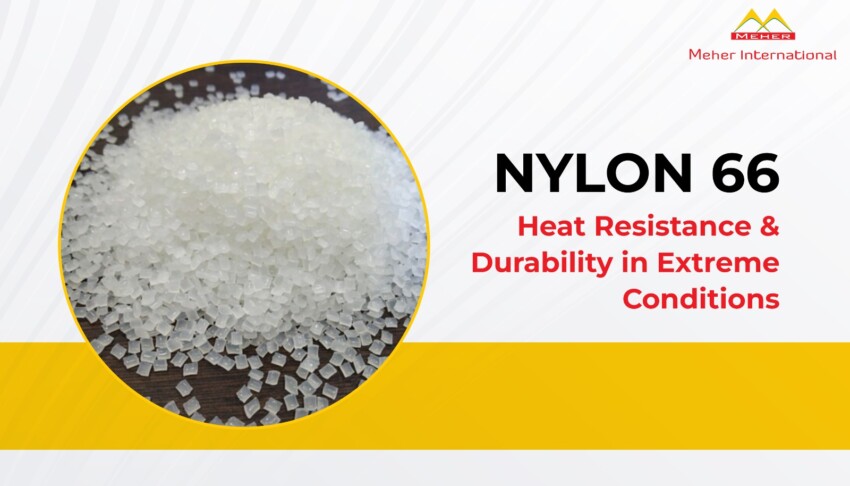
One engineering polymer that has earned a strong reputation for performance in challenging environments is Nylon 66, also known as Polyamide 66 (PA66).
With a combination of high mechanical strength, heat resistance, wear resistance, dimensional stability, and durability, Nylon 66 is widely used in automotive components, industrial machinery, electrical systems, technical textiles, and engineering applications.
For manufacturers, however, the benefit is not simply that Nylon 66 is a “strong polymer.” Its real value comes from how its different properties work together under demanding operating conditions.
This article explores the heat resistance and durability of Nylon 66, its key properties, applications, advantages, limitations, and the importance of choosing a reliable polymer supplier.
What Is Nylon 66 Polymer?
Nylon 66 is a synthetic engineering thermoplastic belonging to the polyamide family.
It is produced from two primary chemical components: hexamethylene diamine and adipic acid. The resulting polymer structure gives Nylon 66 a combination of mechanical and thermal properties that makes it suitable for demanding applications.
Nylon 66 is commonly selected when manufacturers need:
- High tensile strength
- Good stiffness
- Heat resistance
- Wear and abrasion resistance
- Dimensional stability
- Chemical resistance
- Long-term durability
These properties make high-performance Nylon 66 particularly valuable in applications where ordinary plastics may not provide the required performance.
Why Heat Resistance Matters in Engineering Materials
Temperature can significantly influence the performance of polymers.
When exposed to excessive heat, some plastics may soften, deform, lose strength, or experience changes in dimensional stability.
This is a major concern in industries such as:
- Automotive manufacturing
- Electrical and electronics
- Industrial machinery
- Engineering components
- Technical textiles
A material used near an engine, motor, electrical system, or industrial machine may experience continuous or repeated exposure to elevated temperatures.
Nylon 66 offers good thermal performance, making it suitable for applications where heat resistance and mechanical strength need to work together.
However, the exact temperature performance depends on the grade, reinforcement, component design, exposure time, and operating environment.
Key Heat Resistance Advantages of Nylon 66
- Strong Performance at Elevated Temperatures
One of the major reasons manufacturers choose Nylon 66 is its ability to retain useful mechanical properties under elevated-temperature conditions.
This makes it suitable for components that operate in warm or thermally demanding environments.
For applications requiring even greater heat performance, reinforced or specially formulated Nylon 66 grades may be considered.
- Better Dimensional Stability
Heat can cause materials to expand, soften, or deform.
For precision components, even small dimensional changes can affect performance.
Nylon 66 offers good dimensional stability, helping components maintain their intended shape under changing operating conditions.
This is particularly useful for:
- Precision components
- Electrical housings
- Automotive parts
- Mechanical components
- Resistance to Repeated Thermal Exposure
Industrial components may not experience heat only once.
They can repeatedly heat up and cool down during normal operation.
This repeated thermal cycling can place stress on materials.
The thermal characteristics of Nylon 66 make it suitable for applications where components need to operate reliably through repeated temperature changes.
The Durability Advantage of Nylon 66
Heat resistance is only one part of the story.
The real strength of Nylon 66 lies in its combination of thermal, mechanical, and wear properties.
High Mechanical Strength
Nylon 66 is known for its high strength and stiffness.
This makes it suitable for components exposed to:
- Mechanical loads
- Repeated stress
- Vibration
- Impact
- Continuous movement
For industrial designers, this strength-to-weight balance can provide an alternative to heavier materials in selected applications.
People also search for Nylon 66 High Performance apps: Nylon 66 Polymer for High-Performance Applications
Excellent Wear and Abrasion Resistance
Components that move against other surfaces are constantly exposed to friction.
Over time, friction can cause material loss and reduce component life.
Nylon 66 has good abrasion resistance, making it suitable for applications such as:
- Gears
- Bushings
- Bearings
- Rollers
- Guides
- Mechanical components
This can contribute to longer service life when the material is appropriately selected and designed for the application.
Good Chemical Resistance
Industrial environments can expose components to oils, lubricants, fuels, cleaning agents, and other chemicals.
Nylon 66 offers useful resistance to many common chemicals, supporting its use in demanding industrial environments.
However, chemical compatibility should always be evaluated against the specific chemical, concentration, temperature, and duration of exposure.
Nylon 66 in Extreme Industrial Conditions
Extreme conditions do not necessarily mean one specific environment.
A component may face several challenges simultaneously.
For example, an automotive component could experience:
Heat + vibration + mechanical stress + chemicals + repeated operation
Similarly, an industrial component may experience:
Friction + load + temperature + moisture + continuous movement
This is where engineering materials with balanced properties become valuable.
Nylon 66 can offer a combination of characteristics that supports performance across such challenging conditions.
Major Applications of Nylon 66
Automotive Industry
The automotive industry is one of the important application areas for high-performance polyamides.
Nylon 66 can be used for selected:
- Under-the-hood components
- Engine-related parts
- Air-management components
- Electrical connectors
- Cable management parts
- Brackets
- Housings
- Mechanical components
Its combination of strength, heat resistance, and lightweight performance makes it attractive for modern vehicle design.
Electrical and Electronics
Modern electrical systems require materials that can provide mechanical durability and reliable performance.
Nylon 66 is used in suitable electrical applications for:
- Connectors
- Housings
- Cable components
- Protective components
- Insulating parts
Material selection should consider the electrical, thermal, mechanical, and regulatory requirements of the specific application.
Industrial Machinery
Industrial machines often operate continuously.
Components may be subjected to friction, mechanical loads, and elevated temperatures.
Nylon 66 can be considered for:
- Gears
- Bearings
- Bushings
- Rollers
- Guides
- Machine components
Its wear resistance and mechanical strength can support long-term performance in suitable applications.
Technical Textiles
Nylon 66 is also important in textile and industrial yarn applications.
Its strength and durability can make it suitable for performance-oriented textile products where resistance to repeated use is important.
Applications can include:
- Industrial fabrics
- Technical textiles
- High-performance yarns
- Reinforcement materials
Reinforced Nylon 66 for More Demanding Applications
Standard Nylon 66 may not be suitable for every extreme application.
Where greater stiffness, dimensional stability, or mechanical performance is required, reinforced grades can provide additional capabilities.
Glass-fiber-reinforced Nylon 66, for example, can offer improvements in:
- Stiffness
- Strength
- Dimensional stability
- Heat performance
- Load-bearing capability
This makes reinforced Nylon 66 useful for demanding engineering applications.
The correct reinforcement level should always be selected according to the component’s operating requirements.
Nylon 66 vs Other Engineering Polymers
Nylon 66 is one option within a much broader engineering-polymer landscape.
Depending on the application, manufacturers may also evaluate:
- Nylon 6
- PBT
- ABS
- Polycarbonate
- Polypropylene
- Specialty engineering polymers
For example, PBT resins, or Polybutylene Terephthalate, are valued for properties such as dimensional stability, electrical performance, chemical resistance, and low moisture absorption in suitable applications.
The choice between Nylon 66, PBT, or another engineering thermoplastic depends on the application rather than simply selecting the strongest material.
Important considerations include:
- Operating temperature
- Mechanical load
- Chemical exposure
- Moisture
- Wear requirements
- Electrical performance
- Processing method
- Cost
- Required service life
Why Material Quality Matters
Even the best polymer cannot deliver consistent results if material quality varies significantly from batch to batch.
Manufacturers should therefore consider important quality parameters such as:
- Polymer consistency
- Moisture content
- Viscosity
- Mechanical properties
- Thermal characteristics
- Processing behavior
- Batch-to-batch consistency
Quality control becomes particularly important when Nylon 66 is being used for precision engineering or safety-related applications.
Choosing the Right Nylon 66 Supplier
For manufacturers, sourcing the right polymer is a long-term business decision.
A reliable supplier should offer more than competitive pricing.
Businesses should look for:
- Consistent material quality
- Reliable supply
- Technical product knowledge
- Clear product specifications
- International sourcing capabilities
- Timely delivery
- Responsive communication
A dependable supply partner can help manufacturers reduce procurement risks and maintain production continuity.
How Meher International Supports Polymer and Yarn Requirements
Meher International provides a diverse portfolio of polymers, industrial materials, and yarn solutions for businesses across different markets.
Its broader product portfolio includes materials such as:
- Nylon 66 polymer
- Nylon 6 polymer
- PBT resins
- ABS resins
- PET chips
- Industrial yarns
- Technical yarns
- High-performance textile materials
This allows businesses to evaluate multiple material solutions according to their specific application and performance requirements.
Rather than treating every manufacturing challenge the same way, a diversified supplier can help buyers explore materials that better match their intended use.
Why Choose Meher International?
When sourcing industrial polymers and advanced yarns, reliability matters as much as product availability.
Meher International supports businesses with a broad material portfolio and international sourcing capabilities.
Core Benefits
- Diverse polymer and yarn portfolio
- Industrial and technical material solutions
- Reliable sourcing support
- International supply capabilities
- Application-focused product selection
- Professional business communication
- Support for varied manufacturing requirements
For businesses looking for Nylon 66 polymer, Nylon 6, PBT resins, PET chips, or high-performance yarns, this wider portfolio can simplify material sourcing.
Why Meher International Is Best for Your Yarn and Polymer Needs
Extreme applications demand materials that can be trusted.
Nylon 66 has earned its place in demanding industries because it combines strength, heat resistance, wear resistance, dimensional stability, and durability.
But selecting the right material is only the beginning.
You also need a supply partner that understands quality, consistency, application requirements, and international sourcing.
Meher International brings together a diverse range of engineering polymers and yarn solutions to support modern manufacturing and textile requirements.
Choose Meher International for:
- High-quality Nylon 66 and engineering polymers
- Diverse industrial and technical yarn portfolio
- Reliable global sourcing
- Consistent material solutions
- Application-oriented product selection
- Professional business support
- International supply capabilities
Final Thoughts
When materials operate under extreme conditions, performance cannot be compromised.
Heat, friction, mechanical stress, chemicals, and continuous operation can all affect the life of a component. This is why engineering materials must be selected based on the complete operating environment.
Nylon 66 polymer offers an impressive combination of heat resistance, mechanical strength, abrasion resistance, dimensional stability, and durability.
From automotive and electrical components to industrial machinery and technical textiles, its versatility continues to make it an important engineering thermoplastic.
The best material choice, however, depends on the application, grade, formulation, and operating conditions.
For businesses looking for reliable Nylon 66 polymer, engineering thermoplastics, industrial polymers, and performance yarns, Meher International can help bring the right material options together.
Explore Meher International’s polymer and yarn portfolio today and find a reliable material solution for your next industrial requirement.
🌐 Visit: www.meherinternational.com
📧 Email: info@meherinternational.com
📞 Call: +91 261 2328237
📍Address:- 8003 – World Trade Centre, Ring Road, Surat – 395 002, Gujarat, India.
