

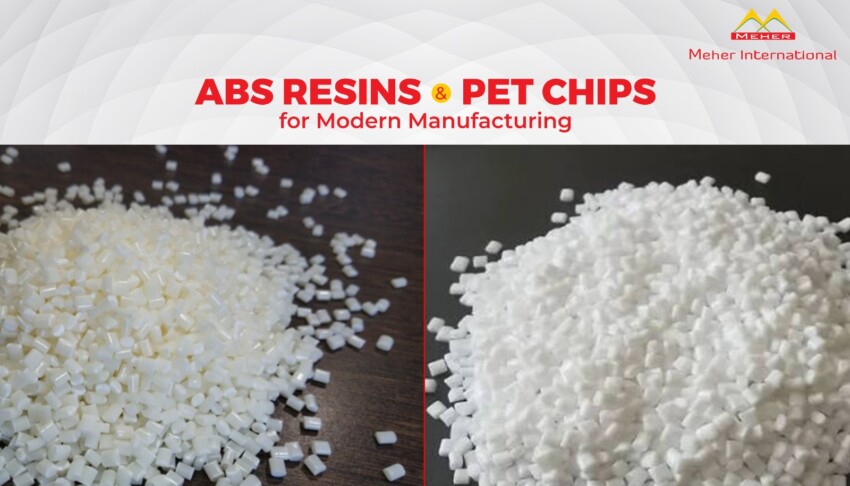
Modern manufacturing depends on materials that can offer the right balance of strength, durability, processability, consistency, and cost efficiency. From automotive components and consumer products to packaging and textiles, the material selected at the beginning of the manufacturing process can directly influence the quality of the final product.
Two important materials that support this diverse manufacturing landscape are ABS resins and PET chips.
Although they serve different purposes, both materials are widely valued for their performance and versatility. ABS resin is known for its toughness, impact resistance, and ease of processing, while PET chips are an important raw material for producing polyester fibers, films, bottles, and other products.
For manufacturers, converters, textile producers, and industrial buyers, understanding these materials is important when selecting the right raw material for a specific application.
As a global supplier of polymers and textile materials, Meher International supports businesses with access to a diverse portfolio of industrial materials designed for modern manufacturing requirements.
This guide explores the properties, applications, advantages, and industrial importance of ABS resins and PET chips — and how reliable sourcing can help manufacturers build better products.
What Are ABS Resins?
ABS stands for Acrylonitrile Butadiene Styrene. It is a thermoplastic polymer widely used in manufacturing because it combines strength, toughness, and good processing characteristics.
ABS is made from three main components:
- Acrylonitrile – contributes chemical resistance and thermal stability.
- Butadiene – improves impact resistance and toughness.
- Styrene – provides rigidity, surface finish, and ease of processing.
The combination of these properties makes ABS resin suitable for products that need to be strong but still relatively lightweight and easy to manufacture.
Why Is ABS Resin Popular?
Manufacturers value ABS because it offers a practical balance between performance and processing efficiency.
Key ABS resin properties include:
- High impact resistance
- Good rigidity
- Excellent surface appearance
- Good dimensional stability
- Easy processing
- Good machinability
- Resistance to many common chemicals
- Lightweight characteristics
This combination allows ABS to be used across a wide range of industries.
Major Applications of ABS Resins
ABS resin is commonly used in products where appearance, durability, and impact resistance matter.
Automotive Components
ABS is widely used in automotive applications for components that require strength without adding unnecessary weight.
Potential applications include:
- Interior components
- Instrument panels
- Trim components
- Housings
- Covers
- Automotive accessories
Its impact resistance and processing flexibility make it useful for complex molded components.
Consumer Electronics
ABS is frequently used for electronic housings and protective components.
Its combination of rigidity and surface finish makes it suitable for:
- Computer components
- Electronic housings
- Appliance parts
- Remote controls
- Electrical enclosures
Household and Consumer Products
ABS resin can also be found in many everyday products.
Examples include:
- Toys
- Luggage components
- Kitchen appliances
- Power-tool housings
- Office equipment
- Sporting goods
Its ability to achieve different shapes and surface finishes gives manufacturers considerable design flexibility.
What Are PET Chips?
PET chips are small polymer pellets made from Polyethylene Terephthalate (PET). They are an important raw material used to manufacture a variety of polyester-based products.
PET is a thermoplastic polymer belonging to the polyester family.
Depending on the grade and intended application, PET chips can be processed into:
- Polyester fibers
- Textile yarns
- Films
- Bottles
- Packaging materials
- Industrial products
For the textile industry in particular, PET chips are an important starting material for producing polyester fibers and yarns.
Why PET Chips Matter in Textile Manufacturing
The quality of the raw material has a direct impact on the performance of the final yarn.
High-quality PET chips can contribute to:
- Consistent spinning performance
- Better fiber quality
- Stable processing
- Uniform yarn characteristics
- Reliable production efficiency
This makes textile-grade PET chips an important consideration for polyester yarn manufacturers.
When manufacturers are purchasing PET chips, factors such as intrinsic viscosity, moisture, purity, color, and consistency may need to be considered depending on the intended application and processing method.
People also you want to PET Chips information: From PET Chips to Textile Grade Yarns: Meher International’s Diverse Portfolio
PET Chips in Polyester Yarn Production
One of the most important applications of PET chips is polyester fiber and yarn manufacturing.
The basic process involves converting polymer chips into a molten form and then processing the material into filaments or fibers.
These fibers can subsequently be converted into different types of textile materials.
PET-based polyester yarn is valued for properties such as:
- Strength
- Durability
- Dimensional stability
- Resistance to wrinkles
- Ease of care
- Good abrasion resistance
This makes polyester suitable for both everyday textiles and performance-oriented applications.
PET Chips Beyond Textiles
The importance of PET chips extends beyond yarn manufacturing.
Packaging
PET is widely used for packaging because of its strength, clarity, and practical processing characteristics.
It can be used in products such as:
- Bottles
- Containers
- Packaging films
Industrial Films
PET can also be processed into films used for electrical, industrial, and packaging applications.
Technical Applications
Specialized PET grades can support applications where consistent polymer performance and dimensional stability are important.
ABS Resins vs PET Chips: Different Materials, Different Roles
ABS resins and PET chips should not be viewed as direct substitutes.
They are used in different manufacturing processes and applications.
ABS is primarily selected when manufacturers need a tough, rigid, easily processed engineering thermoplastic.
PET is often selected when manufacturers require a polyester material for fibers, packaging, films, or other applications.
The right choice depends on:
- Product requirements
- Processing technology
- Mechanical performance
- Temperature exposure
- End-use environment
- Cost considerations
- Required surface finish
Understanding these differences helps manufacturers make more informed raw-material decisions.
Why Material Quality Matters in Manufacturing
Selecting the right polymer is only the first step. Consistency in raw-material quality is equally important.
Variations in polymer characteristics can affect production efficiency and final-product performance.
For example, inconsistent PET chips may influence fiber spinning and yarn quality, while variations in ABS resin may affect molding behavior, appearance, or mechanical performance.
Important Quality Considerations
Manufacturers may evaluate:
- Material purity
- Moisture content
- Melt behavior
- Viscosity
- Color consistency
- Mechanical properties
- Thermal performance
- Batch-to-batch consistency
Reliable quality control helps reduce production issues and supports consistent output.
The Growing Importance of Engineering Thermoplastics
Modern manufacturing is increasingly moving toward materials that provide high performance without excessive weight.
This has increased demand for engineering thermoplastics across industries.
ABS is one such material, while other engineering polymers such as PBT resins, Nylon 6, Nylon 66, and other polymer systems serve more specialized requirements.
Where PBT Resins Fit In
Polybutylene terephthalate (PBT) is another important engineering thermoplastic used where properties such as dimensional stability, electrical performance, chemical resistance, and heat resistance are required.
Industrial PBT is commonly considered for applications in automotive, electrical, electronics, and engineering components.
This broader polymer landscape demonstrates why manufacturers benefit from working with suppliers that understand multiple material categories rather than focusing on a single product.
Sustainability and the Future of Polymer Manufacturing
Sustainability is becoming increasingly important across manufacturing and textile industries.
The focus is shifting toward:
- Better resource utilization
- Recycling
- Recycled polymers
- Longer product lifecycles
- Reduced production waste
- More efficient manufacturing processes
PET has particular relevance in circular manufacturing because polyester products can be collected, processed, and converted into recycled material where appropriate technologies and systems are available.
For manufacturers, sustainability is no longer only about choosing a material. It is also about understanding the material’s entire lifecycle.
How to Choose the Right Polymer Supplier
For industrial buyers, finding a dependable supplier can be just as important as selecting the right material.
A reliable polymer supplier should provide more than a product catalogue.
Look for a partner that offers:
- Consistent material quality
- Reliable sourcing
- Diverse product options
- Technical understanding
- Competitive commercial terms
- Timely delivery
- Export capabilities
- Responsive communication
A strong supply partner can help businesses reduce sourcing uncertainty and maintain smoother production planning.
Why Meher International Is a Reliable Partner for Polymers and Yarns
Meher International offers a diverse portfolio covering polymers, yarns, and textile-related materials for industrial and commercial requirements.
Its product portfolio includes materials such as ABS, PBT, Nylon 6, Nylon 66, PET-related products, and a wide range of textile yarn solutions.
This broader portfolio allows buyers to explore different material options based on their application rather than relying on a one-material-fits-all approach.
Core Product Solutions
Meher International supports businesses looking for:
- ABS resins
- PBT resins
- Nylon 6 polymer
- Nylon 66 polymer
- PET chips
- Textile-grade materials
- Industrial yarns
- Technical yarn solutions
Why Businesses Choose a Specialized Supplier
Working with an experienced supplier can simplify procurement by bringing product knowledge, sourcing capabilities, and international supply support together.
For manufacturers, this can mean:
- Better material selection
- Consistent sourcing
- Reduced procurement complexity
- Access to multiple material categories
- Support for international requirements
Why Meher International Is the Right Choice for Your Polymer and Yarn Needs
Choosing raw materials is a decision that affects more than today’s production run. It can influence product quality, manufacturing efficiency, customer satisfaction, and long-term business performance.
That is why having the right supply partner matters.
Meher International combines a diverse material portfolio with industry-focused sourcing capabilities to help businesses find suitable polymer and yarn solutions.
Whether you are looking for ABS resins for molded components, PET chips for polyester manufacturing, engineering polymers for industrial applications, or high-performance yarns for textile production, the right material can make a measurable difference.
Choose Meher International for:
- Diverse polymer and yarn portfolio
- Industrial-grade material solutions
- Reliable global sourcing
- Consistent quality
- Application-focused product selection
- Professional business support
- International supply capabilities
Final Thoughts
ABS resins and PET chips may serve different purposes, but both play an important role in modern manufacturing.
ABS provides toughness, rigidity, impact resistance, and processing flexibility for a wide range of molded products. PET chips, meanwhile, form the foundation for polyester fibers, yarns, films, packaging, and other applications.
As manufacturing becomes more performance-driven and sustainability-conscious, the importance of selecting the right raw materials will only increase.
For businesses, the goal is not simply to find a material. It is to find the right material, the right quality, and the right supply partner.
Build Better with the Right Materials
Looking for ABS resins, PET chips, engineering polymers, or high-quality textile yarns?
Choose Meher International for dependable material sourcing, a diverse product portfolio, and solutions designed around modern industrial requirements.
Explore Meher International’s polymer and yarn portfolio today and find the right material for your next manufacturing requirement.
🌐 Visit: www.meherinternational.com
📧 Email: info@meherinternational.com
📞 Call: +91 261 2328237
📍Address:- 8003 – World Trade Centre, Ring Road, Surat – 395 002, Gujarat, India.
