

Introduction – What is Bicomponent Yarn?
In the modern textile world, innovation drives everything — from the comfort of our clothes to the efficiency of industrial materials. One such innovation that’s reshaping the textile and nonwoven industry is Bicomponent Yarn.
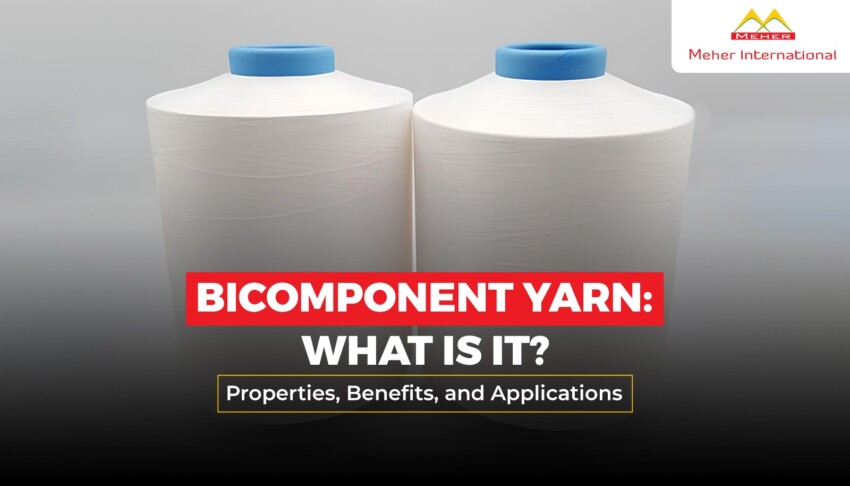
Bicomponent yarn (also known as bico yarn or conjugate yarn) is a fiber or filament made from two different polymers that are extruded together within a single fiber. These polymers can differ in chemical composition, melting point, strength, or elasticity — and this difference is what gives bicomponent yarns their unique and high-performance properties.
In simpler terms, bicomponent yarn combines the best of two materials in one fiber, enhancing functionality, strength, and versatility. Depending on the fiber structure — sheath-core, side-by-side, island-in-sea, or segmented pie — manufacturers can create yarns with specific properties like softness, stretch, resilience, and thermal bonding ability.
Because of these characteristics, bicomponent yarns are now widely used in nonwoven fabrics, apparel, filters, hygiene products, automotive textiles, and industrial materials.
Introduction of Meher International
Meher International, headquartered in Surat, Gujarat, India, is one of the leading names in yarn trading, polymer distribution, and fiber innovation.
With years of expertise and strong partnerships with global leaders such as Jilin Chemical Fiber Group, China, Meher International supplies high-quality yarns and fibers to the textile, nonwoven, and industrial sectors across India and the international market.
The company specializes in a broad range of products, including:
→ Viscose Filament Yarn (VFY)
→ Hi-Tenacity Yarn
→ Low Melt Yarn
→ Recycled Yarn
→ Bicomponent Yarn
→ Engineering Plastics like Nylon 66, PBT, and ABS Resins
Meher International’s mission is simple — to deliver innovation, quality, and sustainability in every thread. With its strong logistics network, deep technical expertise, and commitment to excellence, Meher International continues to be a trusted supplier for yarns and polymers in India and beyond.
Bicomponent Yarn Material Properties
The unique properties of bicomponent yarns come from their dual-polymer construction. Each component contributes to the fiber’s performance, creating characteristics that single-polymer fibers simply cannot achieve.
1. Dual Polymer Construction
A bicomponent fiber combines two different polymers — for example, polyester and polypropylene, or nylon and polyethylene. These polymers can be arranged in various structures, such as:
→ Sheath-core (one polymer forms the outer sheath, the other forms the inner core)
→ Side-by-side (two polymers lie adjacent within the fiber)
→ Island-in-sea (one polymer dispersed as small islands within another polymer matrix)
2. Thermal Bonding Capability
→ One of the most valuable properties of bicomponent yarn is its low-melt bonding ability. The outer sheath can melt and bond fabrics together, while the inner core maintains structural strength.
3. High Elastic Recovery
→ Bicomponent yarns can stretch and return to their original shape, offering excellent elastic recovery. This makes them ideal for stretch fabrics and performance wear.
4. Improved Dyeability
→ Depending on the polymer combination, bicomponent yarns may offer better dye uptake and color consistency, which is essential for fashion and decorative textiles.
5. Enhanced Moisture Management
→ When designed with hydrophilic and hydrophobic components, these yarns can wick moisture away from the skin, keeping fabrics cool and dry — perfect for activewear and hygiene products.
6. Dimensional Stability
→ They maintain shape, strength, and surface texture even after repeated washing or exposure to heat.
7. Softness & Bulk
→ Bicomponent yarns can be engineered for extra softness or bulk, making them suitable for applications where comfort and cushioning are key.
Advantages of Using Bicomponent Yarn
1. Enhanced Fabric Performance
→ Bicomponent yarns offer a perfect blend of strength, elasticity, and comfort, resulting in high-performance fabrics that can withstand stress and moisture.
2. Energy Efficiency
→ In thermal bonding processes, the low-melting sheath reduces the need for high temperatures, saving energy and lowering carbon emissions.
3. Eco-Friendly Manufacturing
→ Since bicomponent yarns allow for thermal bonding without adhesives, the manufacturing process is cleaner, reducing chemical waste.
4. Superior Bonding & Cohesion
→ In nonwoven production, bicomponent fibers bond tightly, creating strong, durable fabrics with excellent dimensional stability.
5. Design Versatility
→ Manufacturers can customize bicomponent yarns to deliver desired properties like crimp, stretch, luster, or texture.
6. Better Comfort and Feel
→ In apparel applications, bicomponent yarns provide soft, breathable, and lightweight fabrics that enhance user comfort.
7. Cost-Effective Production
→ The combination of two polymers allows manufacturers to achieve multiple functionalities without needing expensive coatings or treatments.
8. Recyclability
→ Certain bicomponent yarns are designed to be fully recyclable, supporting the growing movement toward sustainable textile manufacturing.
Common Applications of Bicomponent Yarn
1. Nonwoven Fabrics
→ Used in hygiene products, medical textiles, and home furnishings. Their thermal bonding and softness make them ideal for lightweight yet durable fabrics.
2. Apparel & Sportswear
→ Perfect for activewear, undergarments, and high-performance clothing, providing stretch, breathability, and comfort.
3. Automotive Industry
→ Used in car seat fabrics, headliners, and insulation materials, improving aesthetics, comfort, and strength.
4. Home Textiles
→ Ideal for upholstery, curtains, carpets, and bed linens, offering resilience and easy maintenance.
5. Filtration & Industrial Applications
→ Used in air and liquid filters, industrial felt, and protective materials due to their high strength and bonding ability.
6. Hygiene & Medical Textiles
→ Used in medical masks, sanitary pads, and disposable clothing — ensuring softness, breathability, and absorbency.
Why Purchase Bicomponent Yarn from Meher International?
1. Global Sourcing Excellence
→ Meher International imports from reputed international manufacturers known for consistent quality.
2. Diverse Yarn Portfolio
→ Supplies bicomponent, viscose, recycled, hi-tenacity, and low melt yarns for multiple industries.
3. Quality You Can Trust
→ Every consignment goes through stringent quality control to ensure performance and reliability.
4. Technical Expertise
→ Offers expert consultation to help clients choose the right bicomponent yarn type for their applications.
5. Competitive Pricing
→ Provides cost-efficient solutions through strong supplier relationships.
6. Sustainable & Future-Ready
→ Supports eco-friendly yarn sourcing to help clients align with green manufacturing goals.
7. Timely Delivery & Logistics Support
→ Ensures on-time delivery of products across India and international markets.
Conclusion – Bicomponent Yarn: Innovation Woven into Every Fiber
From medical masks to car seats, from sportswear to nonwoven fabrics — bicomponent yarn is shaping the future of textiles. Its dual-polymer structure, superior bonding, and soft texture make it one of the most versatile and valuable innovations in modern manufacturing.
With sustainability and efficiency at the forefront of textile production, bicomponent yarn stands as the perfect balance between performance and eco-responsibility.
When it comes to sourcing premium-quality bicomponent yarns, Meher International remains the trusted partner for manufacturers across the globe.
Call to Action – Partner with Meher International
Looking for high-quality bicomponent yarn suppliers in India?
Connect with Meher International, your trusted yarn and polymer trading partner in Surat, Gujarat.
→ Visit: www.meherinternational.com
→ Email: info@meherinternational.com
→ Call: +91 261 2328237
→ Address:- 8003 – World Trade Centre, Ring Road, Surat – 395 002, Gujarat, India.
Let’s weave innovation and sustainability — together.
